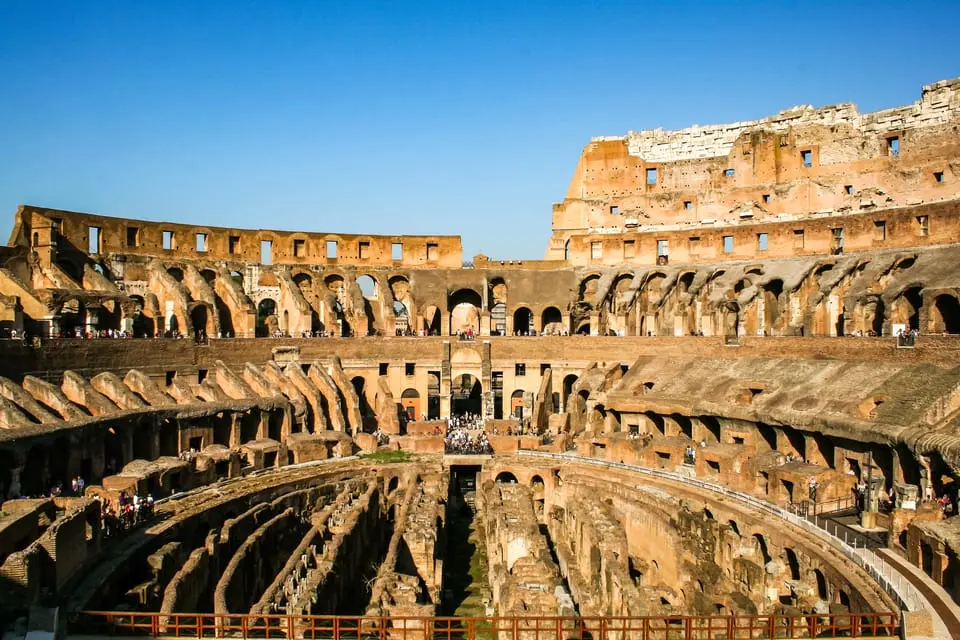
Beneath the arena of the Colosseum lies its most extraordinary feature: the hypogeum, a two-level labyrinth of tunnels, chambers and machinery that powered the games. It was the backstage of the ancient world’s greatest spectacle — hidden from the crowd above, yet responsible for everything they saw. Today it’s one of the most compelling parts of a Colosseum visit, and one of the few areas that requires a specific ticket or guided tour to access. Here’s what it is, how it worked, and how to see it in 2026.
Key facts
- Built: approximately 81–96 AD by Emperor Domitian — not part of the original 80 AD Colosseum.
- What it contained: animal cages, gladiator holding areas, ~24–32 lifts and trapdoors, scenery storage, drainage.
- How to visit: official Full Experience Underground & Arena ticket (€24 + €2 fee) or a licensed guided tour.
- Accessibility: stairs, uneven ground, low ceilings — not wheelchair accessible; best for ages 8 and up.
What is the hypogeum?
The word hypogeum comes from the Greek for “underground.” It refers to the network of passages directly beneath the Colosseum’s arena floor — the hidden operational layer that made the spectacles above possible.
This was where wild animals were held in cages in the hours before their appearance, where gladiators waited and mentally prepared for combat, where scenery and props were stored, and where an intricate system of lifts and trapdoors controlled what appeared in the arena and when.
Because the original wooden arena floor is long gone, modern visitors can look straight down into this hidden world from the seating tiers above — a maze of brick corridors and stone channels that the 50,000 spectators who filled the seats never saw.
Worth adding to your Rome itinerary
Other Rome experiences to explore
If the Colosseum hypogeum is on your list, you’re probably interested in ancient Rome more broadly. The Roman Forum and Palatine Hill are included with your Colosseum ticket and are a natural extension of the day — the Forum in particular brings the Colosseum’s era to life in a way no museum exhibit can. The Circus Maximus is a short walk from the Palatine and gives a sense of the scale of Roman public entertainment beyond the arena. For anyone with a deeper interest in Roman history, the Capitoline Museums house the best collection of ancient Roman sculpture in the world, including the original equestrian statue of Marcus Aurelius and artefacts excavated directly from the Forum below.
When was it built?
Here’s a detail that surprises many visitors: the hypogeum was not part of the original Colosseum. The amphitheatre opened in 80 AD under Emperor Titus, but the underground was added roughly a decade later by his younger brother, Emperor Domitian, around 81–96 AD.
That timing explains a well-known change in the games programme. Before the hypogeum was dug, the arena could reportedly be flooded for mock naval battles (naumachiae). Once Domitian installed the underground infrastructure, flooding became structurally impossible, and those aquatic spectacles ended for good. The trade-off was worth it: the lift-and-trapdoor system opened up a new vocabulary of dramatic surprise that defined Colosseum spectacle for the rest of its operational life.
How the machinery worked
The hypogeum was a feat of Roman engineering, built entirely around the need for theatrical effect. Its purpose was to make animals, fighters and scenery appear in the arena suddenly, dramatically, and seemingly from nowhere.
- Lifts and shafts: sources vary, but the system involved roughly 24 to 32 lifts set into vertical shafts rising through both underground levels. Smithsonian Magazine notes somewhere between 24 and 28 lifts, each engineered to raise loads of up to around 600 pounds.
- Capstans: each hoist was worked by teams of men turning capstans — large, horizontal winches — hauling caged animals or performers upward on ropes. The coordination required was considerable; multiple lifts often operated simultaneously during a single spectacle.
- Trapdoors: at the top of each shaft, a trapdoor in the arena floor opened at the right moment, and the load — a lion, a bear, a gladiator, a piece of scenery — rose into the light and noise of the arena above, appearing as if conjured from the earth itself.
- Drainage: an elaborate drainage system carried rainwater and groundwater away through the subterranean infrastructure into Rome’s great sewer, the Cloaca Maxima.
Highest-rated underground experience
Rome: Colosseum Underground and Roman Forum Small Group Tour
The highest-rated underground tour we track with real review volume — 4.8/5 from 714 reviews. A small-group guided descent into the hypogeum, then the arena floor and the Roman Forum, with the kind of detailed explanation that makes the lift shafts and capstan rooms make complete sense as you stand in them. Underground dates open further ahead than the arena options: the nearest at our last check was 2 November 2026, at $203 per person.
Check AvailabilityThis site is an independent booking guide and may earn a commission if you book through our partner link.
The Ludus Magnus connection
One of the most evocative features of the hypogeum is a blocked corridor that once led to the Ludus Magnus, the main gladiator training school located just outside the Colosseum on the Via Sacra side. Through this tunnel, gladiators could walk directly from their barracks to the arena without ever stepping onto a public street — moving from training to combat entirely underground, hidden from the crowds and the city above.
The remains of the Ludus Magnus are still visible today in an excavated area beside the Colosseum — you pass them on the approach from the Forum side. Standing in the hypogeum and looking at that blocked corridor, you can trace the exact route a gladiator would have walked on the morning of a fight. Note that the Ludus Magnus site itself has been closed to public entry since August 2024 for restoration work, with no confirmed reopening date as of 2026 — it can still be viewed for free from street level, but it isn’t currently open to walk through.
Rediscovering the underground
For centuries after the games ended, the hypogeum lay buried, filled in, and overgrown. Systematic excavation from the 1990s onwards gradually uncovered the tunnels, and after a major restoration completed in 2021, the underground reopened to visitors with a suspended walkway that lets you move through the space while looking down into the corridors, lift shafts and technical rooms below. The walkway keeps visitors above the excavated floor level, preserving the archaeology while giving a clear view of the layout.
How to visit the hypogeum in 2026
The underground is a restricted area. There are two ways to access it:
- The official Full Experience Underground and Arena ticket (€24, plus the €2 non-refundable booking fee). This gives self-directed access to the underground with Colosseum staff present, plus the arena floor and 2-day validity for the Forum and Palatine.
- A licensed guided tour that specifically includes underground access. Tours typically also include the arena floor, Roman Forum and Palatine Hill, and come with a guide who explains the machinery in context as you walk through it.
Either way, you are always accompanied — there is no free-roaming, self-guided access to the hypogeum.
Booking ahead is essential. Official underground slots release 30 days in advance on ticketing.colosseo.it (the exact release hour varies by source, but it's first thing in the morning) and frequently sell out within minutes on popular dates. If you miss that window, six specific Full Experience Underground & Arena shifts (roughly 12:30, 13:45, 15:50, 16:20, 16:50 and 17:20) release again just 7 days before your visit date — a useful fallback worth checking even after the 30-day slots are gone. If official tickets are unavailable entirely, a guided tour with its own ticket allocation is usually the only realistic way in. See our full prices guide for the cost breakdown, and our tickets guide for how the booking system works in detail.
Underground and arena in one guided tour
Rome: Colosseum Underground and Arena Tour
A guided tour combining the hypogeum and the reconstructed arena floor in one visit — the two spaces that together give the fullest picture of how the Colosseum actually operated. 4.8/5 from 300+ reviews. Reserved timed entry, expert guide, and your own ticket allocation so you’re not dependent on official underground availability.
Check AvailabilityPractical notes before you go
- Accessibility: the underground involves stairs, uneven surfaces and low ceilings. It is not wheelchair accessible and is best suited to ages 8 and up. If mobility is a concern, confirm the specific route with your operator before booking.
- Duration: underground tours typically run about 3 hours in total, usually including the arena floor and often the Roman Forum and Palatine Hill. The time inside the hypogeum itself is around 45–60 minutes.
- What to wear: closed-toe shoes with grip. Parts of the walkway are exposed and temperatures in the underground can be cooler than the arena above, especially in the morning.
- Photography: photography is permitted in the hypogeum. The lighting is atmospheric rather than bright, so a phone with a decent low-light mode works well.
Is the hypogeum worth seeing?
If you want to understand how the games actually worked — the logistics, the machinery, the human effort behind the spectacle — the hypogeum is unmatched anywhere in the ancient world. Standing in the tunnels where gladiators waited, looking up at the trapdoor shafts through which lions appeared out of nothing, is a far more visceral experience than viewing the arena from the stands above.
For most visitors who make the effort to book it, the hypogeum is the highlight of their entire time in Rome. For the historical context of what happened in these tunnels — who built the Colosseum, how the games worked, and what the gladiators’ lives were actually like — our inside the Colosseum history guide is a useful companion to read before your visit.
Frequently asked questions
What is the Colosseum hypogeum?
The hypogeum is the two-level underground network of tunnels and chambers directly beneath the Colosseum’s arena floor. It was where wild animals were caged, gladiators waited before their fights, and an elaborate system of lifts and trapdoors raised both into the arena above.
Who built the Colosseum underground?
Emperor Domitian, around 81–96 AD — approximately a decade after the Colosseum opened under his brother Titus in 80 AD. The hypogeum was not part of the original building.
Can you visit the Colosseum underground?
Yes, but only with the official Full Experience Underground and Arena ticket (€24 + €2 booking fee) or on a licensed guided tour with underground access. You are always accompanied by staff or a guide — there is no free-roaming self-guided access to the hypogeum. For a full explanation of both options and how to book when the official portal sells out, see our guide: can you visit the Colosseum underground without a tour?
How did the Colosseum lifts work?
Teams of men turned capstans to raise lifts through vertical shafts. At the top, a trapdoor in the arena floor opened and the load — an animal, a performer, scenery — rose into view. The system involved roughly 24–32 lifts, each capable of raising loads of up to around 600 pounds.
Is the hypogeum different from the arena floor?
Yes. The hypogeum is the underground tunnel network. The arena floor is the reconstructed wooden surface at ground level where the gladiators fought. The official Full Experience Underground and Arena ticket includes both together in a single self-booked product — you don’t need a guide to see both, just advance booking. For what you actually see and experience standing on the arena itself, see our Colosseum arena floor tour guide.
Is the Colosseum underground wheelchair accessible?
No — the hypogeum involves stairs, uneven ground and low ceilings, and is not wheelchair accessible. It is generally best suited to visitors aged 8 and above.
Walk the tunnels that powered the games
Book your Colosseum underground experience before slots sell out
Official underground tickets release 30 days ahead and sell out fast. Guided tours with their own allocations are the best fallback when official slots are gone — and they add the context that makes the hypogeum make sense. Book as early as your dates allow.
€26 (official Full Experience Underground + fee) · From ~$57 (guided underground tour)
Check AvailabilityThis site is an independent booking guide and may earn a commission if you book through our partner link.
Related reading:
- All Colosseum Underground Tours: Compare 19 Guided Tours
- Colosseum Underground Tour: Explore the Hypogeum & Arena Floor (2026)
- Inside the Colosseum: History, Gladiators & What Remains Today
- Colosseum Arena Floor Tour: Tickets, Access & Is It Worth It?
- How Much Does the Colosseum Cost? Ticket Prices Explained (2026)
- Colosseum Tickets 2026: Every Ticket Type Explained
- Arena Floor vs Underground: Which Tour Is Worth It in 2026?