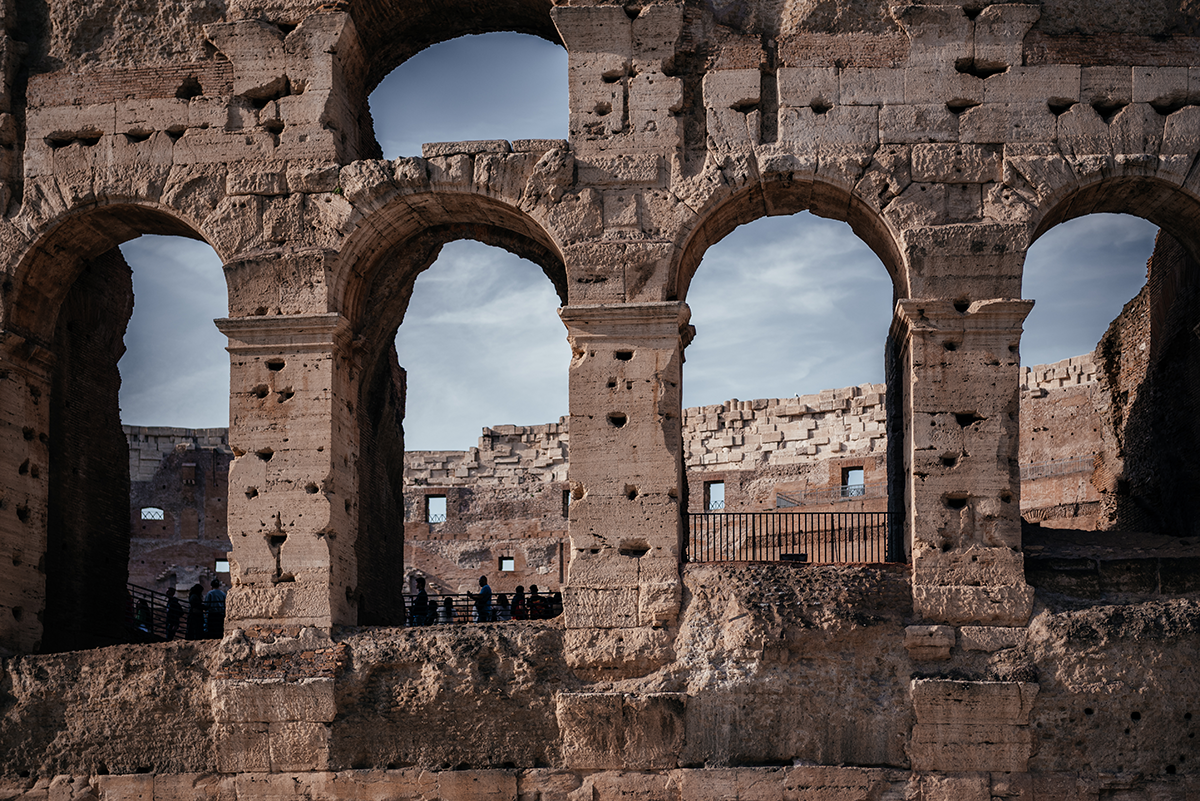
Most visitors see the Colosseum from the stands. A Colosseum underground tour takes you where the crowds can’t go — down into the hypogeum, the two-level maze of tunnels beneath the arena where gladiators waited, wild animals were caged, and a system of lifts and trapdoors sent both up into the light of the games.
This is the single most atmospheric way to experience the amphitheatre. Because the underground is a restricted area, it’s only reachable with the right ticket or a licensed guide. Here’s exactly what you’ll see, what it costs in 2026, and how to secure a spot before they sell out.
The short answer
- What you’ll see: the hypogeum tunnels, the gladiator gate corridor, and the reconstructed arena floor — all off-limits with a standard ticket.
- 2026 official price: €24 for the Full Experience Underground and Arena ticket (€32 with an included educator); guided third-party tours from ~$85–$250.
- Key rule: the underground is always accompanied — there is no free-roaming self-guided access.
What is the Colosseum underground?
The hypogeum (from the Greek for “underground”) is the subterranean network directly below the arena floor. It was not part of the original building — Emperor Domitian had it constructed around 81–96 AD, roughly a decade after the Colosseum opened in 80 AD. Before it existed, the arena could reportedly be flooded for mock naval battles; once the hypogeum was dug, that stopped for good.
Think of it as the backstage of the ancient world’s greatest show. Down here, teams of workers operated an intricate machine of shafts, capstans and hoists to raise scenery, animals and fighters into the arena on cue — often erupting from trapdoors to the roar of 50,000 spectators.
The modern visitor route matters too. The restored hypogeum people walk today is not an improvised path picked through ruins: after major restoration work, the fully reopened underground route returned in 2021 with a new protected walkway system. That is precisely why access remains limited, controlled and guided — and why it sells out the way it does.
Worth adding to your Rome itinerary
Other experiences you might enjoy
Rome rewards time beyond the Colosseum. The Vatican Museums and Sistine Chapel are an obvious next stop, and many visitors pair them with a guided walk through St Peter’s Basilica. Closer to the Colosseum, a dedicated Roman Forum and Palatine Hill tour adds depth if you want more time at the archaeological park than a combined underground ticket allows. The Borghese Gallery and the Castel Sant’Angelo are also popular half-day additions that complement a morning at the Colosseum.
What you’ll see on the tour
A Colosseum underground tour typically covers three zones the standard ticket doesn’t:
- The hypogeum tunnels. Walk the restored passages on a suspended walkway, looking down into the corridors, animal holding areas and the vertical lift shafts that fed the arena. Your guide points out the technical rooms and the drainage channels that once carried water into Rome’s Cloaca Maxima.
- The gladiator gate and Ludus Magnus corridor. A blocked tunnel marks the passage that once connected the Colosseum directly to the Ludus Magnus, the gladiator training school next door — fighters could walk to the arena without ever seeing the street.
- The arena floor. Most underground tours also include the reconstructed arena floor, letting you stand at the centre where the games took place and look up at the tiers exactly as a gladiator would have.
- Original brickwork and floor remains. The visible traces of the infrastructure that once powered the lifts and trapdoors — the physical evidence behind the engineering your guide describes.
- Upper interior views. The first and second tiers, usually with broader interpretation of crowd hierarchy, seating by social rank, and the staging of imperial spectacle.
Many tours continue into the Roman Forum and Palatine Hill, which are included on the same ticket, making it a half-day journey through the heart of ancient Rome. The Forum and Palatine sections supply the context; the descent supplies the emotional shift.
In practical terms, the underground tour is not simply “a better ticket.” It is a different shape of experience. Standard visitors look down into the mechanism. Underground visitors walk inside it.
Most-Reviewed Underground Tour
Colosseum: Underground and Ancient Rome Tour
The best-reviewed underground experience on GetYourGuide. Guided access to the hypogeum, arena floor, Roman Forum and Palatine Hill in one 3-hour itinerary. 1,500+ verified reviews.
Check AvailabilityThis site is an independent booking guide and may earn a commission if you book through our partner link.
How the lifts and trapdoors worked
The hypogeum was a feat of engineering. Sources vary on the exact numbers, but the system involved roughly 24 to 32 lifts and dozens of vertical shafts, each hoist worked by teams of men turning capstans. Smithsonian Magazine notes the lifts were designed to raise loads of up to around 600 pounds — enough for a caged animal to appear, seemingly from nowhere, in the middle of the arena. Trapdoors above each shaft opened to complete the illusion.
The network also included secret tunnels connecting the gladiator training school — the Ludus Magnus — directly to the arena, letting fighters arrive below the sightline of the crowd. Holding cells, animal pens, and a basic treatment area for wounded combatants completed the picture. The hypogeum was the powerhouse of Roman spectacle: a place of controlled chaos hidden beneath the noise and the applause.
2026 tickets & prices
The hypogeum can only be visited with the official Full Experience Underground and Arena ticket or on a licensed guided tour. It is always staff- or guide-accompanied — there is no free-roaming self-guided access to the underground.
| Ticket / tour | Price (2026) | What’s included |
|---|---|---|
| Standard 24h ticket (official) | €18 + booking fee | Colosseum tiers 1–2, Roman Forum, Palatine Hill. No arena floor, no hypogeum — the lowest-cost way in |
| Full Experience Arena (official) | €24 + booking fee | The standard route plus the reconstructed arena floor. The best fallback when underground slots are gone |
| Full Experience Underground & Arena (official) | €24 adult, €2 reduced (EU 18–24) | Hypogeum, arena floor, Colosseum levels 1–2, + Roman Forum & Palatine over 2 days. The fullest official access |
| Official “full entry + educational tour” | €32 | As above, with an accompanied educational visit led by a PArCo educator |
| Full Experience Attic (official) | €24 + booking fee | The upper panoramic levels rather than the underground. Best for photography and repeat visits — see our Colosseum attic tour guide |
| Third-party guided underground tour | ~$85–$250 | Same physical access with a guide, skip-the-ticket-line entry, usually Forum & Palatine; price varies by group size and operator |
A €2 online booking fee applies to official tickets. Reduced pricing is for EU citizens aged 18–24; under-18s enter free but still need a booked timed slot.
Heads-up: Official underground slots release exactly 30 days in advance on ticketing.colosseo.it (generally in the morning, Rome time — sources disagree on the exact hour) and often sell out within minutes. If you miss that window, check back 7 days before your visit: six specific daily Full Experience Underground & Arena time slots re-release at that point. If both are gone, a reputable guided tour with its own ticket allocation is usually the only realistic way in. For a full breakdown of all tour types, see our Colosseum guided tours comparison.
Small-Group Option
Rome: Colosseum Underground Small Group Guided Tour
Capped at 8 people. Compact 1.5-hour format focused on the underground chambers and gladiator passageways, with Roman Forum and Palatine Hill tickets included. 300+ verified reviews.
Check AvailabilityBooking and availability: the honest version
Yes, official underground tickets exist. In practice they are among the hardest tickets in Rome to secure. On the most desirable dates in peak season, the 30-day release can be gone within minutes of opening.
There are conditions worth knowing before you build a trip around one. Official underground tickets are name-locked, require ID matching the booking, and are generally non-refundable and non-reschedulable. Children under 18 still need a reserved ticket inside the same booking even though their entry is free. For anyone planning around real-world constraints rather than theory, those rules matter nearly as much as the price does.
That is why a lot of travellers end up with a third-party operator. The value is not that they unlock a secret area nobody else can reach — it is the same hypogeum, on the same restricted route. The value is that they are simpler to book, often include cancellation flexibility, and package the route in a way that works when you are booking inside a tighter window.
The trade-off is cost and certainty. Official tickets are far cheaper when you can actually get them. Third-party tours charge a premium for convenience, language certainty, guiding, and pre-arranged allocations. One real caveat: many operators do not receive final underground confirmation until roughly two weeks before the date, which is why time changes, late itinerary adjustments and occasional downgrades to arena-only access do happen. The right choice depends less on abstract value than on your situation — how fixed your dates are, how far ahead you are booking, and whether you care more about the lowest price or the least planning friction.
Is the underground tour worth it?
If you have any interest in how the games actually worked — the machinery, the staging, the human and animal logistics behind the spectacle — it’s the most rewarding version of a Colosseum visit. Standing in the tunnels where gladiators waited their turn is something the view from the stands simply can’t match.
A few practical notes: the hypogeum involves stairs, uneven surfaces and low ceilings, so it is not wheelchair accessible and is best for ages 8 and up. Tours run rain or shine, but parts are exposed, so dress for the weather.
Not sure which underground tour format suits your group? Our full guide to Colosseum guided tours compares group, small-group, private, and night options side by side.
Who should book this tour
Good fit
- First-time visitors with one Rome trip: if you want the most complete Colosseum route and don’t mind paying extra for it.
- History-focused travellers: especially if Roman engineering and the logistics of spectacle are part of the appeal.
- Repeat visitors: people who have already walked the standard route and want the part they missed.
- Photographers: the hypogeum and arena floor offer angles the public circuit simply doesn’t reach.
Probably not the right fit
- Tight-budget travellers: the arena floor delivers most of the emotional payoff for considerably less.
- Visitors with mobility limitations: stairs, uneven surfaces and the underground route make this a poor accessibility choice.
- Short visits: if you only want a quick Colosseum stop, the full route is more tour than you need.
Good to know before you go
- Duration: Underground + arena + Forum/Palatine tours usually run about 3 hours.
- Security: Everyone passes through metal detectors and bag screening. Skip-the-line skips the ticket queue, not security. Bags larger than 30×40×15 cm are refused and there’s no cloakroom.
- ID: Tickets are named; bring photo ID that matches the booking.
- Best time: Enter at the 8:30am opening or in the last couple of hours before closing, ideally Tuesday–Thursday in spring or autumn.
Meeting points
Most operators meet near the Colosseum at Largo Gaetana Agnesi, on Via dei Fori Imperiali, or around the Arch of Constantine. The exact point always comes from your booking confirmation. Arrive early enough that a delay doesn’t become a no-show — late arrivals are rarely accommodated.
What to bring
Photo ID matching the booking name, comfortable shoes, water, and only a small bag. In summer the exposed Forum and arena sections get punishingly hot, while the hypogeum itself stays noticeably cooler — worth a thin layer even in August.
Accessibility
The underground is not wheelchair accessible, and it is a poor choice for anyone who struggles with stairs, claustrophobia, or long walks on uneven historic surfaces. There are no bathrooms once you are on the hypogeum route, so use the facilities before the Colosseum portion begins.
Children and family fit
For older children and teenagers the underground is often the most memorable part of the whole visit. For toddlers or anyone with a stroller it is a much weaker fit, and families wanting an easier route are usually better served by a standard or arena ticket.
Frequently asked questions
Can you visit the Colosseum underground without a guide?
No. The hypogeum is a restricted area accessible only with the Full Experience Underground and Arena ticket or a licensed guided tour, and you are always accompanied by a staff member or guide. For a full breakdown of both options, what the standard ticket allows, and how to get in when the official portal sells out, see our dedicated guide: can you visit the Colosseum underground without a tour?
How much is the Colosseum underground tour?
The official Parco archeologico del Colosseo Full Experience Underground and Arena ticket is €24 (plus a €2 booking fee), or €32 for the version with an included PArCo educator. Guided third-party tours range from roughly $85 to $250 depending on group size and inclusions. For a full cost breakdown across all ticket tiers, see our Colosseum prices guide, and for the history and mechanics of what you’ll see down there, our complete hypogeum guide covers the lifts, trapdoors, and the Ludus Magnus tunnel.
How far in advance should I book?
As early as possible. Official tickets are released 30 days ahead and underground slots frequently sell out the same morning. Book the moment your date opens, or choose a guided tour with its own ticket allocation.
Is the arena floor included in the underground tour?
Yes — the Full Experience Underground and Arena ticket and most underground guided tours include the reconstructed arena floor. Standing at the centre and looking up at the tiers is one of the highlights of the visit.
Bottom line
The Colosseum underground tour is worth it when your priority is rare access and a fuller understanding of how the amphitheatre actually worked. It is not automatically the best value for every traveller. The arena floor remains the stronger fallback for many first-time visitors because it delivers most of the emotional payoff for much less, and the standard ticket is still the smartest budget choice. But if what you want is the route that makes the Colosseum feel like a machine rather than a ruin, the underground is the one that does it.
Book the Tour
Experience the Colosseum like most visitors never do
Underground access, arena floor entry, the Roman Forum and Palatine Hill — in one guided tour. Limited spots available each day.
From $83 per person (group tour) · €24 official ticket
Check AvailabilityThis site is an independent booking guide and may earn a commission if you book through our partner link.
Related reading:
- All Colosseum Underground Tours: Compare 19 Guided Tours
- Colosseum Guided Tours: Which One Is Right for You? (2026)
- Colosseum Attic Tour: the Top Tier and Belvedere Explained (2026)
- Arena Floor vs Underground: Which Tour Is Worth It?
- Colosseum Tickets 2026: Every Ticket Type Explained