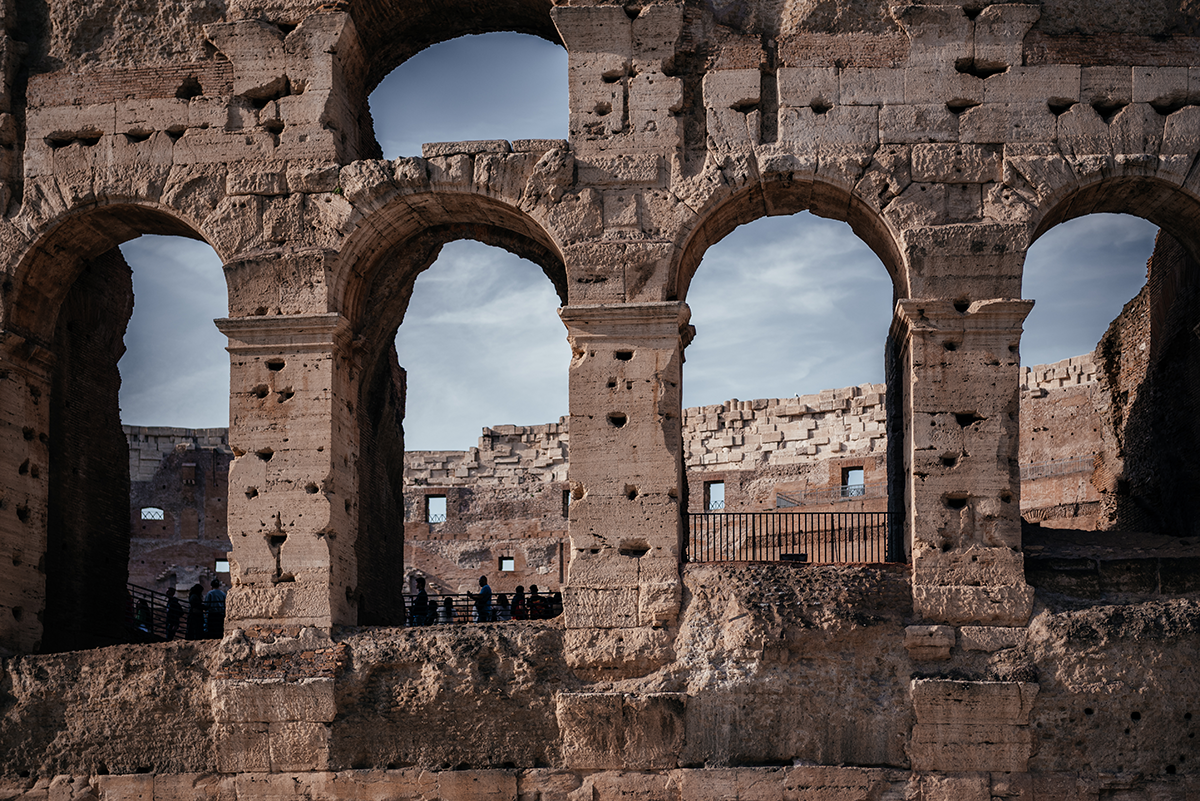
For nearly two thousand years, the Colosseum has stood as the symbol of Rome — a monument to imperial ambition, engineering genius, and the spectacle of the games. Step inside and you’re standing in the world’s largest ancient amphitheatre, a place that once held tens of thousands of roaring spectators. This is its full story: who built it, how the games worked, and what survives for visitors to see today.
Key facts at a glance
- Built: 70–80 AD by the Flavian emperors (Vespasian, Titus, Domitian).
- Capacity: approximately 50,000 spectators.
- What happened here: gladiatorial combat, animal hunts, executions, and staged spectacles.
- What you can see today: tiers, arena floor, underground hypogeum — depending on your ticket.
- UNESCO World Heritage Site since 1980 and one of the New Seven Wonders of the World.
Who built the Colosseum, and when?
The Colosseum’s proper name is the Flavian Amphitheatre, after the dynasty that built it. Emperor Vespasian began construction around 70–72 AD, funded largely by the spoils of the sack of Jerusalem. His son Titus inaugurated it in 80 AD with 100 days of games that became legendary in ancient sources. A second son, Domitian, later added the top level and built the underground hypogeum around 81–96 AD.
There was a deliberate political message in its location. The amphitheatre was built on the drained lake of Nero’s hated private pleasure palace, the Domus Aurea — a gesture of returning land seized by a tyrant back to the Roman people. Its popular name, “Colosseum,” likely derives from the nearby Colossus of Nero, a giant bronze statue that once stood beside it.
Worth adding to your Rome itinerary
Other Rome experiences to explore
If the Colosseum is your starting point, ancient Rome has far more to offer nearby. The Roman Forum and Palatine Hill are a natural extension of any Colosseum visit — they share a ticketing system and are a short walk from the main entrance. A guided tour of the Circus Maximus or the Baths of Caracalla puts the gladiatorial era in broader context. For visitors who want to understand the complete ancient city, a walking tour of the Imperial Fora or a visit to the Capitoline Museums — which houses the original bronze statue of Marcus Aurelius and much of what was found in the Forum — rounds out the picture considerably.
How big was it?
The scale is staggering even by modern standards. The Colosseum measures roughly 189 by 156 metres at its outer wall, stands about 48–50 metres high, and contains an arena of around 87 by 55 metres. Capacity is commonly estimated at 50,000 spectators, with some ancient sources suggesting up to 80,000.
Crowds entered through 76 numbered arches (plus four ceremonial entrances for dignitaries) and were seated strictly by social rank — the closer to the arena floor, the higher your status. Senators sat at ringside; women and the poor were relegated to the uppermost tiers, furthest from the action.
The velarium: an ancient retractable roof
On hot Roman days, a vast retractable awning called the velarium was pulled out over the seating to shade the crowd. Its rigging was anchored by 240 mast corbels, the stone brackets still visible around the top of the outer wall today. The velarium was operated by a detachment of Roman sailors from the imperial fleet — men practised with ropes, rigging and canvas. It was, in effect, an ancient stadium roof, and the corbels are one of the most overlooked details visible from the street outside.
The games: gladiators, hunts and spectacle
The Colosseum hosted several distinct kinds of spectacle over its centuries of operation:
- Gladiatorial combat (munera): the famous armed contests between trained fighters. Gladiators were professional athletes — expensive to train and maintain — and death in the arena was less common than popular imagination suggests. A skilled gladiator was too valuable to kill casually.
- Animal hunts (venationes): exotic beasts from across the empire — lions, bears, elephants, crocodiles, rhinoceroses — were shipped to Rome and killed in elaborately staged hunts. Ancient sources record that upward of 9,000 animals were killed during the inaugural 100 days of games alone.
- Public executions: condemned criminals were sometimes killed in the arena, sometimes in the form of staged mythological scenes where the role of a dying character was played by the real condemned.
- Mock naval battles (naumachiae): in the early years before the hypogeum was added, the arena floor could be flooded for staged sea battles. Once the underground chambers were built, this stopped entirely — the two uses were incompatible.
Walk the gladiators’ route
Rome: Colosseum Gladiator’s Arena and Roman Forum Tour
A guided tour focused on the gladiatorial history of the Colosseum, with access to the arena floor and the Roman Forum. Standing on the reconstructed arena surface — where gladiators actually fought — brings the history on this page to life in a way no amount of reading can replicate.
Check AvailabilityThis site is an independent booking guide and may earn a commission if you book through our partner link.
Beneath the arena: the hypogeum
The hypogeum was the Colosseum’s backstage — a two-level network of tunnels and chambers beneath the arena floor, added by Domitian after the original opening. This is where animals were caged in the hours before their appearance, where gladiators waited and prepared, and where scenery and props were stored.
A system of roughly 24 to 32 lifts and numerous shafts, worked by teams of men turning capstans, raised animals and performers through trapdoors directly into the arena floor above — appearing as if from nowhere to a crowd that had no view of the machinery below. A blocked corridor still marks the tunnel that once connected the Colosseum to the Ludus Magnus, the gladiator training school that stood next door.
Today the original wooden arena floor is gone, leaving the underground chambers exposed and visible from above. This is why you can look down from the seating tiers and see the tunnel grid below — it’s one of the most distinctive and striking views inside the monument. With the right ticket, you can descend into those tunnels and walk the space where the gladiators waited. For a full account of the underground experience, see our Colosseum underground tour guide.
See the underground for yourself
Colosseum: Underground and Ancient Rome Tour
A guided tour with access to the Colosseum underground chambers, arena floor, second tier, Roman Forum, and Palatine Hill. 4.5/5 from 1,100+ reviews — this is the most-reviewed underground tour available. Your guide puts the hypogeum into context as you walk the tunnels where gladiators and animals once waited.
Check AvailabilityThe end of the games and the Colosseum’s later life
The games did not last forever. The last gladiatorial contests are traditionally dated to the early 5th century — around 404–438 AD — with the story of the monk Telemachus marking a symbolic turning point. Animal hunts continued somewhat longer, but as the empire fragmented and the economic and logistical machinery that sustained the games collapsed, the spectacles faded.
After the games ended, the Colosseum lived many further lives. It served as a quarry for building stone — much of the marble, iron, and bronze that once clad it was stripped away — then as a fortress, housing, workshops, a religious shrine, and eventually a sacred site with a history of Christian martyrdom (though historians debate the evidence). Major earthquakes in 847 and 1349 brought down large sections of the outer southern wall, giving the building its distinctive broken silhouette on that side.
What remains today
Modern visitors can see a remarkable amount of the original structure still in place. The standing fabric includes:
- The outer wall and arches, three-quarters of which still stand, bearing the marks of the velarium rigging corbels near the top
- The seating tiers, where the social hierarchy of ancient Rome is still legible in the layout
- The arena floor, partly reconstructed so you can stand at its centre and look up at 50,000 empty seats rising around you
- The hypogeum, the exposed tunnels and lift shafts visible from the tiers above and accessible with the right ticket
- Permanent exhibitions on gladiatorial culture, construction, and the monument’s history
The Colosseum is a UNESCO World Heritage Site (designated 1980) and was voted one of the New Seven Wonders of the World in 2007. It remains Italy’s most-visited cultural site, welcoming nearly 15 million visitors in 2024. For practical advice on tickets, what each ticket includes, and how to book, see our 2026 Colosseum tickets guide.
Frequently asked questions
Who built the Colosseum?
Emperor Vespasian began it around 70–72 AD; his son Titus inaugurated it in 80 AD with 100 days of games; and Domitian later added the top tier and built the underground hypogeum in the 80s–90s AD.
How many people did the Colosseum hold?
Capacity is commonly estimated at around 50,000 spectators, with some ancient sources suggesting up to 80,000. The seating was arranged by social rank, with senators and the elite at ringside and the general public in the upper tiers.
What happened inside the Colosseum?
Gladiatorial combat, wild-animal hunts, public executions, staged mythological spectacles — and, in the early years before the hypogeum was built, even mock naval battles on a flooded arena floor.
Can you go inside the Colosseum today?
Yes. A standard ticket covers the tiers, exhibition halls, and views down into the exposed hypogeum. With the right ticket or guided tour, you can also access the reconstructed arena floor or descend into the underground chambers themselves.
How long does it take to visit the Colosseum?
Allow 1.5–2 hours for the standard visitor route. If your ticket includes the arena floor or underground, budget 2–3 hours inside the Colosseum. Add 20–30 minutes for security queues in peak season even with a pre-booked ticket. See our best time to visit guide for how to plan around the crowds.
See the history in person
Book a Colosseum tour with underground or arena floor access
Reading the history is one thing; standing in the hypogeum where gladiators waited, or on the arena floor where they fought, is quite another. The underground and arena floor are the two spaces that turn the Colosseum from a ruin into a working picture of the ancient spectacle.
From ~$83+ per person (guided underground or arena tour)
Check AvailabilityThis site is an independent booking guide and may earn a commission if you book through our partner link.
Related reading:
- Colosseum Attic Tour: the Top Tier and Belvedere Explained (2026)
- All Colosseum Underground Tours: Compare 19 Guided Tours
- Colosseum Underground Tour: Explore the Hypogeum & Arena Floor (2026)
- Colosseum Arena Floor Tour: Tickets, Access & Is It Worth It?
- Colosseum Tickets 2026: Every Ticket Type Explained
- Colosseum, Roman Forum & Palatine Hill Ticket: One Pass, Three Sites
- Colosseum Guided Tours: Which One Is Right for You? (2026)