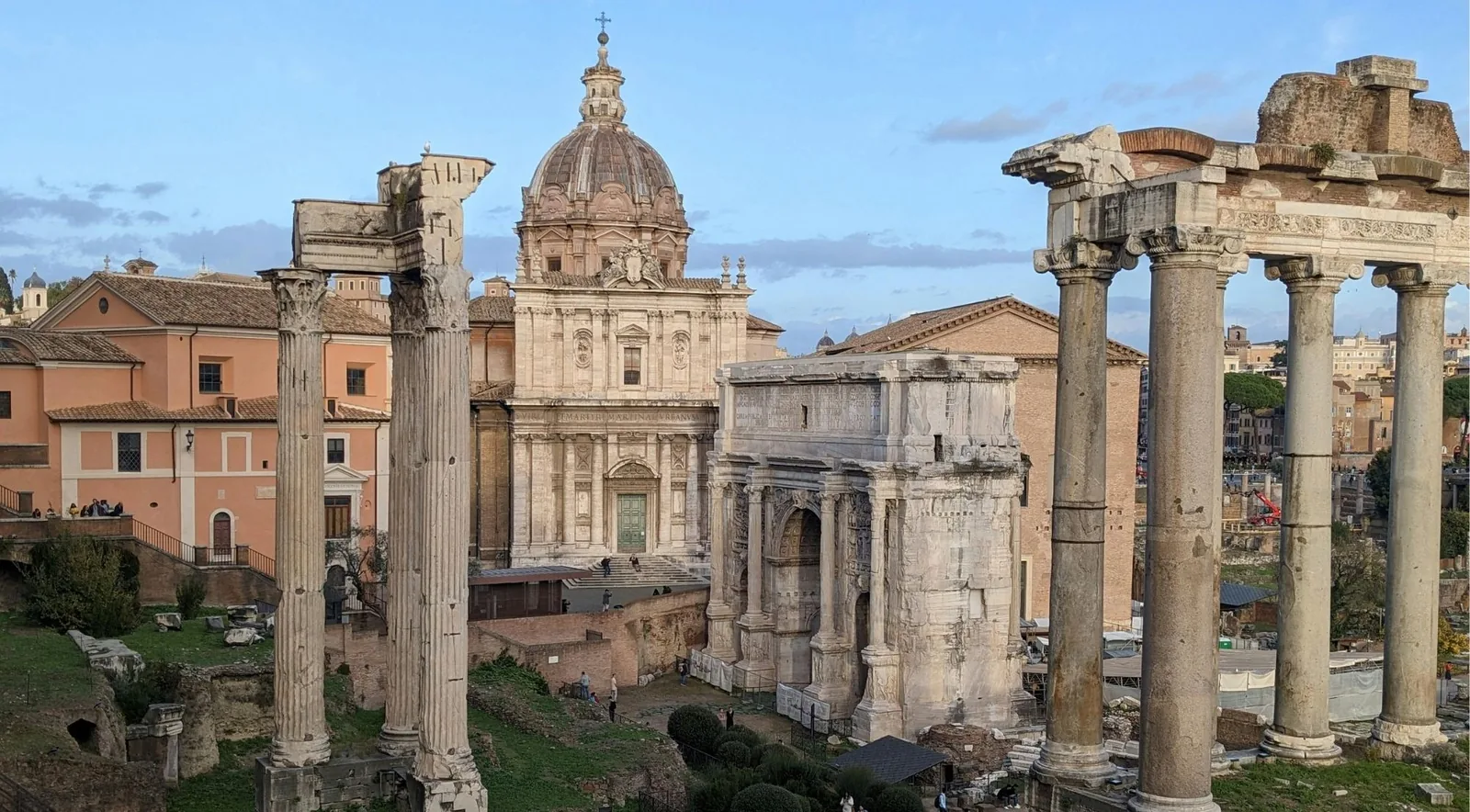
Right beside the Colosseum lie two of the most important sites in the ancient world: the Roman Forum, the civic and political heart of ancient Rome, and Palatine Hill, the legendary birthplace of the city and the private address of the emperors. Most visitors don’t realise that both are included with every Colosseum ticket — no separate purchase needed. Here is everything you need to see them properly in 2026.
Key facts
- Included with: every official Colosseum ticket — Standard, Full Experience, all tiers.
- Open: from 9:00am; closing between 4:30pm and 7:15pm depending on season.
- Time needed: 2–3 hours for both at a comfortable pace.
- Best entrance: Via di San Gregorio or Largo della Salara Vecchia — the Colosseum-side gate is exit-only.
- SUPER sites (House of Augustus, House of Livia, etc.) require a Full Experience or Forum Pass ticket.
Included with your Colosseum ticket
This is the key thing to know before you go: you don’t buy the Forum and Palatine separately. Every official Colosseum ticket admits you to all three sites. With a Standard ticket you have 24 hours of flexibility; with Full Experience tickets you get two consecutive days. Most visitors do the Colosseum on its timed slot, then walk straight over to the Forum and Palatine, which share the same archaeological park immediately alongside.
For a full breakdown of how the combined ticket works — prices, validity, SUPER sites, and booking — see our Colosseum, Forum & Palatine ticket guide.
Worth adding to your Rome itinerary
Other Rome experiences to explore
The Roman Forum and Palatine Hill are the natural companions to a Colosseum visit — but Rome has no shortage of other ancient and historic sites to pair them with. The Capitoline Museums, immediately above the Forum, hold the world’s finest collection of ancient Roman sculpture and are easy to combine with a Forum visit. The Circus Maximus is a short walk south of the Palatine, and its scale — it held 250,000 spectators — puts even the Colosseum in perspective. For visitors interested in early Christian Rome, the Basilica of San Clemente has three layers of history stacked directly below street level and is one of the most rewarding sites in the city.
The Roman Forum: what to see
The Forum was the civic, political and religious centre of ancient Rome for nearly a thousand years — the place where laws were made, business was done, emperors were mourned, and triumphs were celebrated. Even in ruin, it’s one of the most atmospheric spaces in Europe. The key sights to look for:
- Temple of Saturn — the eight surviving Ionic columns are the Forum’s most photographed ruins, dating from 498 BC (with later reconstruction). The state treasury was once housed here.
- Temple of Vesta & House of the Vestal Virgins — the circular temple where the sacred flame of Rome burned continuously, beside the elongated courtyard residence of the Vestal priestesses who tended it.
- Temple of Castor and Pollux — three elegant Corinthian columns marking one of the Forum’s oldest temples, dedicated after the legendary battle of Lake Regillus.
- Arch of Titus — a triumphal arch at the Forum’s eastern end, built after Titus’s destruction of Jerusalem in 70 AD. The carved reliefs inside the arch show the menorah and other spoils being carried to Rome — proceeds that helped fund the Colosseum.
- Arch of Septimius Severus — a grander, more elaborate arch at the Forum’s western end, celebrating campaigns against the Parthians.
- Curia Julia — the Senate House, remarkably intact because it was converted into a church in the 7th century. The original bronze doors were moved to St John Lateran.
- Basilica of Maxentius — the Forum’s largest building, a vast three-aisled hall whose surviving coffered vaults give the strongest sense of the scale of Roman architecture at its height.
- Via Sacra — the ancient processional road running through the heart of the Forum, from the Arch of Titus near the Colosseum all the way up to the Capitoline Hill.
Most-reviewed guided tour of all three sites
Rome: Colosseum, Palatine Hill and Roman Forum Guided Tour
A fully guided tour covering the Colosseum, Roman Forum, and Palatine Hill in one route — 4.8/5 from 35,000+ verified reviews, making it the most-reviewed combined-site tour available. Your guide connects all three sites so the history reads as a continuous story rather than separate ruins. Reserved timed entry included.
Check AvailabilityThis site is an independent booking guide and may earn a commission if you book through our partner link.
Palatine Hill: what to see
Rising directly above the Forum, Palatine Hill is where Rome began — the hill of Romulus and Remus, where the city’s first settlements stood — and where, centuries later, the emperors built their vast private palaces. The views alone justify the climb, but the ruins reward time spent exploring them.
- Domus Flavia & Domus Augustana — Domitian’s sprawling palace complex from the 1st century AD, covering much of the hilltop. The two wings — one for official functions, one for private residence — together define the footprint of the hill.
- House of Augustus & House of Livia — the intimate, beautifully preserved painted rooms of Rome’s first emperor and his wife. These are part of the SUPER sites (Full Experience or Forum Pass required), and some of the most remarkable ancient interiors accessible to visitors anywhere in Rome. House of Augustus closes Mondays; House of Livia closes Tuesdays.
- Domus Tiberiana — an earlier imperial palace complex currently being restored, with new areas expected to open in coming years.
- Farnese Gardens — Renaissance gardens laid out in the 16th century over earlier imperial ruins, offering welcome shade and the best terrace views over the Forum below.
- Panoramic views — from the Palatine’s edges you can see across the Forum in one direction and down to the Circus Maximus and the Aventine Hill in the other. On a clear day the views extend to the Alban Hills beyond the city.
The SUPER sites
Full Experience and Forum Pass tickets include the SUPER sites — a curated set of specially preserved spaces not accessible to Standard ticket holders. Beyond the House of Augustus and House of Livia on the Palatine, the SUPER access also includes Santa Maria Antiqua in the Forum (a 6th-century church with extraordinary Byzantine frescoes, one of the oldest Christian buildings in Rome) and the Aula Isiaca, a room decorated with Egyptian-themed frescoes from the time of Augustus.
If ancient painting and imperial interiors are of interest, these are genuinely worth seeking out — the House of Augustus in particular contains rooms as vivid as Pompeii and far less visited. Check day-specific closures before planning your route.
Opening hours (2026)
The Roman Forum and Palatine Hill open at 9:00am — half an hour after the Colosseum — and close on the same seasonal schedule as the whole archaeological park:
| Season (2026) | Closing time | Last admission |
|---|---|---|
| 29 March – 30 September | 7:15pm | 6:15pm |
| 1 October – 24 October | 6:30pm | 5:30pm |
| 25 October – 28 February 2027 | 4:30pm | 3:30pm |
Both sites are closed on December 25 and January 1. For detailed Colosseum opening hours and the best time of day to visit, see our opening hours and best time guide.
Highest-rated Forum & Palatine guided tour
Rome: Colosseum Guided Tour with Roman Forum and Palatine
A guided tour covering the Colosseum, Roman Forum, and Palatine Hill with a 4.7/5 rating — the highest-rated option for this three-site combination. Smaller group than the large-group tours, with an expert guide who gives the Forum and Palatine the time and attention they deserve rather than rushing between sites.
Check AvailabilityBest entrances
The Forum and Palatine share several gates, and choosing well saves time:
- Via di San Gregorio — a Palatine entrance on the south side, typically far less crowded than the main tourist approach.
- Largo della Salara Vecchia — another quieter option, entering the Forum from the north side near the Via dei Fori Imperiali.
- The gate nearest the Colosseum is exit-only for the Forum and Palatine. A common mistake is to walk to it expecting to enter — you can’t.
Visitor tips
- Wear good shoes. The Forum and Palatine are large, uneven, and mostly unshaded. In summer the paving stones get intensely hot. Comfortable, closed-toe footwear and a water bottle are essential.
- Allow 2–3 hours. Both sites together are substantial. Rushing the Forum in under an hour means missing most of what makes it significant.
- Go early or late. Midday sun is fierce and there is little shade across the Forum floor. Morning or late afternoon is dramatically more comfortable, and the light is better for photography.
- Consider a 2-day ticket. The Full Experience ticket gives 2-day validity. Doing the Colosseum one day and the Forum and Palatine the next is a far better experience than trying to do all three in one tired afternoon.
- Get some context. On-site signage is limited. An audio guide, a knowledgeable guide, or at minimum a good map transforms what you see. Without it, even the most impressive ruins can seem like an undifferentiated expanse of stones.
Frequently asked questions
Do I need a separate ticket for the Roman Forum and Palatine Hill?
No. Both are included with every official Colosseum ticket — Standard, Full Experience, and all other tiers. There is no separate purchase. See our combined ticket guide for the full breakdown of what each tier includes.
How long does it take to see the Roman Forum and Palatine Hill?
Allow about 2–3 hours to explore both at a comfortable pace. The Forum alone can take 1.5 hours if you want to see it properly; the Palatine adds another hour or more, especially if you visit the SUPER sites.
What are the opening hours?
They open at 9:00am and close between 4:30pm and 7:15pm depending on the season, with last admission one hour before closing. See the table above for the 2026 seasonal schedule, and our opening hours guide for full details.
Which entrance is best?
The Via di San Gregorio and Largo della Salara Vecchia gates are usually the least crowded. The gate nearest the Colosseum is exit-only — don’t plan to enter there.
What are the SUPER sites?
A set of specially preserved spaces — including the House of Augustus, House of Livia, Santa Maria Antiqua, and the Aula Isiaca — included with Full Experience and Forum Pass tickets but not Standard admission. Some of the most remarkable ancient interiors accessible to visitors in Rome. Check day-specific closures before planning your route.
Should I get a guide or audio guide for the Roman Forum and Palatine Hill?
Strongly recommended. On-site signage is limited and the ruins can be confusing without context. A licensed guide or audio tour transforms what looks like a field of ancient rubble into a legible picture of one of history’s greatest cities. For a comparison of guided tour options, see our Colosseum guided tours guide. For the practical details most people miss — ticket rules, the one-entry policy, SUPER access and time planning — see our guide on what nobody tells you before visiting the Roman Forum.
See all three ancient sites on one pass
Book your Colosseum, Forum & Palatine tour
All three sites are covered by one ticket — and a guided tour that covers all three in a single route gives far more than a self-guided wander. Reserved timed entry, a licensed guide, and the context that makes every arch and column mean something.
From ~€55+ per person (guided three-site tour)
Check AvailabilityThis site is an independent booking guide and may earn a commission if you book through our partner link.
Related reading:
- All Colosseum Underground Tours: Compare 19 Guided Tours
- Colosseum, Roman Forum & Palatine Hill Ticket: One Pass, Three Sites
- Inside the Colosseum: History, Gladiators & What Remains Today
- Colosseum Opening Hours, Last Entry & The Best Time to Visit
- What to See in Rome: The Perfect 3-Day Itinerary (2026)
- Colosseum Guided Tours: Which One Is Right for You? (2026)