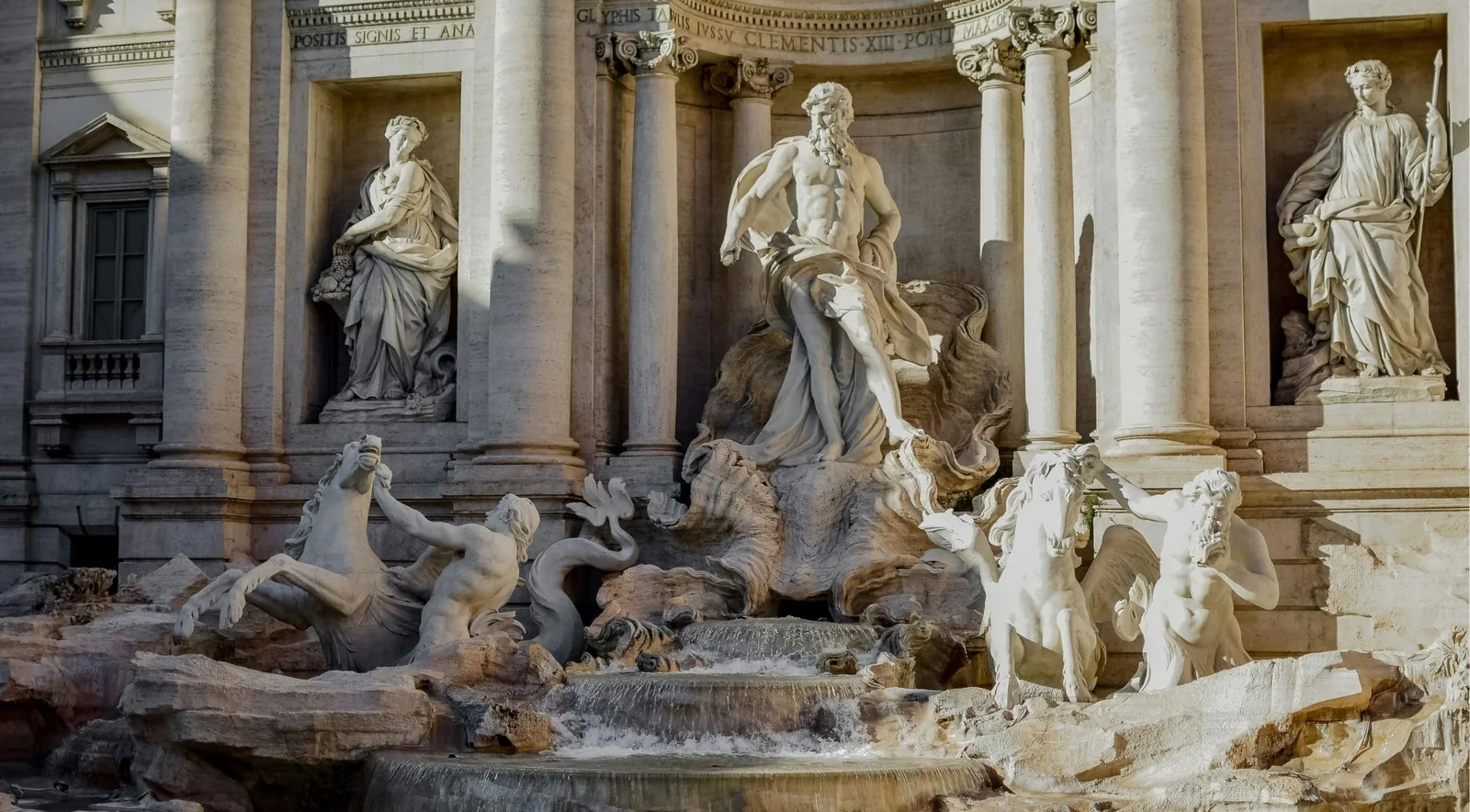
Almost everyone visits the Trevi Fountain. Almost no one knows that a few metres beneath it lies an entire ancient world — Roman houses, a working aqueduct, and a water system that still feeds the fountain above. A Trevi Fountain underground tour takes you into Vicus Caprarius, one of Rome’s most rewarding hidden gems.
Quick facts
- What it is: Vicus Caprarius — the “City of Water” — ancient Roman ruins 9 metres below street level, steps from the Trevi Fountain.
- The headline detail: the Aqua Virgo aqueduct visible here has been running continuously for over 2,000 years and still supplies the Trevi Fountain above.
- Admission: ~€4 (reduced ~€2.50, free under 14).
- Hours: Tue–Sun, roughly 11:00am–5:00pm. Closed Mondays.
- Booking: recommended; often required on weekends.
What is Vicus Caprarius?
Vicus Caprarius — the “City of Water” — is an archaeological site about 9 metres below street level, just steps from the Trevi Fountain. It was discovered by chance during renovations to a cinema between 1999 and 2001, and opened to the public in 2004.
What survives underground is remarkable: the remains of an ancient insula (apartment block) and domus (house) dating from the era of Nero, a stretch of the Aqua Virgo — the only ancient Roman aqueduct still in operation — and a castellum aquae, a water-distribution tank where water still flows today. Excavated artefacts on display include a striking marble head identified as Alexander-Helios.
More of Rome beneath the surface
Other underground Rome experiences worth exploring
Rome’s most extraordinary spaces are often the ones you descend into. The Colosseum underground takes you into the hypogeum — the two-level network of tunnels where gladiators waited in darkness before being raised into the arena above. The Capitoline Museums, built over the ancient heart of the city, hold the greatest collection of Roman sculpture in the world. And if the history of the Aqua Virgo at Vicus Caprarius leaves you curious about Roman aqueducts, the Colosseum itself was originally built over a drained lake fed by Nero’s aqueduct — a detail that makes its underground tunnels even more remarkable.
The aqueduct that still feeds the Trevi
Here’s the detail that makes the site unforgettable: the Aqua Virgo, built in 19 BC, is still working after more than two thousand years — and it’s the very aqueduct that supplies the water cascading over the Trevi Fountain above your head. Standing beside the flowing channel underground, you’re looking at living Roman engineering, not just ruins.
What you’ll see
- Ancient Roman living quarters — walls, rooms and floors of homes from imperial Rome
- The Aqua Virgo aqueduct, still carrying water after more than two millennia
- The castellum aquae water-distribution tank, where water still flows today
- Archaeological finds on display including sculpture, coins and everyday objects
- A quiet, atmospheric space that is a world away from the crowds at the fountain above
Prices and opening hours
- Standard admission: ~€4
- Reduced (students, seniors): ~€2.50
- Under 14: Free
- Opening days: Tuesday–Sunday (closed Mondays)
- Hours: Roughly 11:00am–5:00pm
- Booking: Recommended; often required on weekends
Guided combination tours pairing the fountain above with the underground below run from around €35.
How to visit
You can visit Vicus Caprarius independently for the low admission fee, or join a guided tour that combines the Trevi Fountain above with the City of Water below. A guide adds the historical context that makes the site come alive — how the aqueduct worked, who lived here, and how the layers of Rome stack on top of one another across two thousand years.
Because the site is small and popular, book ahead, especially for weekend visits. The site fits naturally into a historic-centre day alongside the Pantheon and Piazza Navona — all are within easy walking distance. For a ready-made plan that includes the Trevi Fountain on Day 3, see our 3-day Rome itinerary.
A perfect Rome add-on
Vicus Caprarius pairs beautifully with a day in the historic centre — it’s steps from the Trevi Fountain and within easy walking distance of the Pantheon and Piazza Navona. If you enjoy the idea of Rome’s underground layers, this is the same thrill in miniature as the Colosseum underground: descending beneath the modern city to find the ancient one still intact. For first-time visitors planning their Rome trip, our essential guide for first-time visitors covers how to fit stops like this into a realistic itinerary.
For the full subterranean experience across your Rome trip, pair Vicus Caprarius with a Colosseum underground tour. The hypogeum beneath the Colosseum — two levels of tunnels, lift shafts and gladiator waiting rooms — is the grander and more dramatic of Rome’s underground spaces, but the two complement each other rather than compete. Vicus Caprarius is quieter, more intimate, and tells a different story.
Pair with Rome’s other great underground
Colosseum: Underground and Ancient Rome Tour
The most-reviewed Colosseum underground experience on GetYourGuide — 4.5/5 from 1,100+ verified reviews. Includes the hypogeum, arena floor, Roman Forum and Palatine Hill in one 3-hour guided itinerary. If Vicus Caprarius leaves you wanting more of Rome beneath the surface, the Colosseum underground is the natural next step — larger in scale, dramatic in atmosphere, and an entirely different chapter of Roman history.
Check AvailabilityThis site is an independent booking guide and may earn a commission if you book through our partner link.
Frequently asked questions
Is there really an underground beneath the Trevi Fountain?
Yes — Vicus Caprarius, the “City of Water,” lies about 9 metres below street level just steps from the fountain. It contains the remains of ancient Roman homes and a section of the Aqua Virgo aqueduct that still carries water today.
How much does the Trevi Fountain underground cost?
Admission to Vicus Caprarius is around €4 (reduced ~€2.50, free for under 14s). Guided tours combining the fountain and the underground site start from about €35.
What are the Vicus Caprarius opening hours?
Roughly 11:00am–5:00pm, Tuesday to Sunday. It is closed on Mondays, and booking is recommended — often required on weekends due to the site’s small capacity.
Does the aqueduct still work?
Yes. The Aqua Virgo, visible inside the site, is the only ancient Roman aqueduct still in continuous operation. Built in 19 BC to supply the baths of Agrippa, it has been running ever since — and it still feeds the Trevi Fountain above your head as you stand underground.
Is the Trevi Fountain underground worth visiting?
For anyone drawn to Rome’s hidden, underground side, yes — it is a quiet, inexpensive and genuinely fascinating stop just steps from one of the city’s busiest landmarks. The combination of flowing ancient water, Roman architecture and near-total absence of crowds makes it one of the most rewarding short detours in the historic centre.
Related reading:
- All Colosseum Underground Tours: Compare 19 Guided Tours
- What to See in Rome: The Perfect 3-Day Itinerary (2026)
- Rome for First-Time Visitors: The Essential Travel Guide (2026)
- Colosseum Underground Tour: Explore the Hypogeum & Arena Floor (2026)
- The Colosseum Hypogeum: A Complete Guide to the Underground